
Entrepreneurs on Fire – Advanced Business Idea Generator Worksheet
Discover What Drives You
Purpose: Identify patterns of passion, strength, and curiosity.
“When you align what excites you with what helps others—you’ve found your fire.”
EOF Exercise:
Ask yourself the following questions. Write your answers in your workbook.
What do you love talking about for hours?
Example: “Fitness, motivation, small business success”
What world problem tugs at your heart?
Example: “Waste reduction”
What problems frustrate you that you’d pay to solve?
Example: “Scheduling chaos — I built my own planner system”
What activities make you lose track of time?
Example: “Designing graphics, teaching others”
What challenges have you personally overcome?
Example: “Transitioning from a 9–5 to freelancing”
What would you still do if you never got paid?
Example: “Coaching people through mindset shifts”
What topic do people always ask your opinion on?
Example: “Marketing and productivity tools”
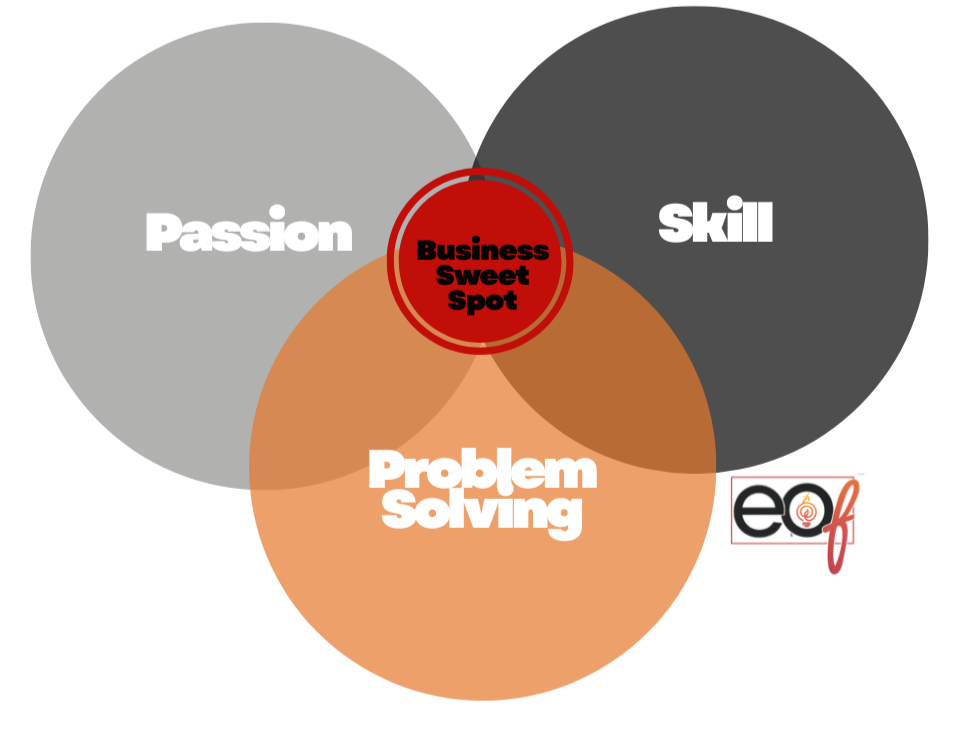
Insight: Passion creates momentum, but clarity creates consistency. Look for the overlap of energy and expertise.
💬 Tip: Circle themes that repeat. Those are the sparks of purpose.
Find Skills That Sell
Your Value Inventory
“People don’t pay for what you know—they pay for what your knowledge does for them.”
🔶 Purpose
To translate what you already know, do, or love into something people will gladly pay for. This step bridges the gap between your skills and the transformation you create for others.
Examples:
Graphic Design
How You Apply It: Building simple websites for small businesses
Who It Helps: Local entrepreneurs
Value/Outcome: Professional online presence
EOF Exercise: Find the Fire in Your Skills
For each skill, ask yourself:
Does it save time, money, or energy?
Example: “My design templates help small businesses launch faster.”
Can it be repeated or packaged into a service or product?
Example: “Turn one-on-one coaching into a group course or mini guide.”
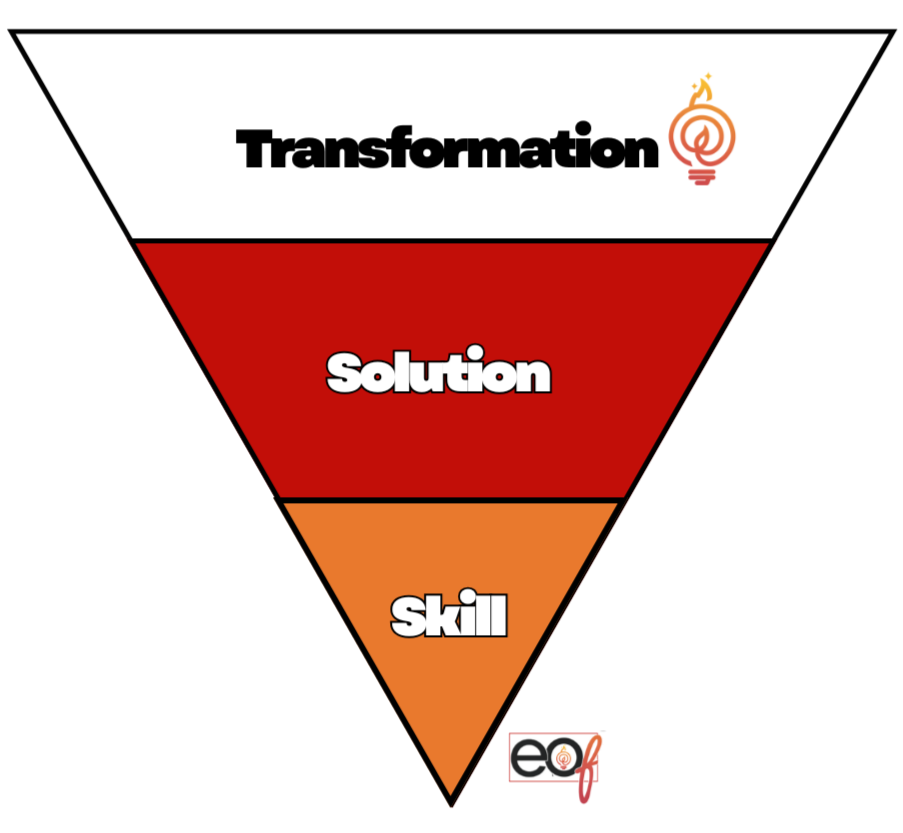
Interpretation:
Skill: What you can do.
Solution: How you apply it to solve someone’s problem.
Transformation: The emotional or tangible outcome you deliver.
💬 Example:
Skill: Cooking → Solution: Quick, healthy meals for busy parents → Transformation: Less stress, more energy.
Writing
How You Apply It: Ghostwriting LinkedIn content
Who It Helps: Executives
Value/Outcome: Builds authority and engagement
Does it create confidence, clarity, or income?
Example: “My social media guidance helps clients show up online consistently.”
✅ If you answered “yes” to any — that skill has monetizable value.
Organizing
How You Apply It: Creating digital filing systems
Who It Helps: Small business owners
Value/Outcome: Saves time and reduces stress
Skill-to-Value Matrix

Go Deeper
Next Action Step
Pick one to three skills that feel both useful and exciting.
Write one sentence that describes its value:
“I help [who] do [what] so they can [benefit].”
Example:
“I help small business owners design their online presence so they can attract clients with confidence.”
Then, move to the next phase: Problem Discovery Map — to find where your skill meets the market’s needs.
Productivity Planners
Problem Discovery Map
🔶 Purpose
Identify meaningful, profitable problems.
Step 1
List Problems You See
“Parents don’t have time to cook healthy meals.”
“New freelancers don’t know how to find clients.”
“Small businesses waste money on bad marketing.”
Step 2
Identify Emotional Triggers
Stress, confusion, fear, guilt, frustration.
Example:
Problem: “I can’t stay consistent on social media.”
Transformation: “Confidence and clients through consistent visibility.”
Business: “A done-for-you content calendar + accountability coaching.”
Step 3
Identify Desired Transformations
Time freedom, clarity, confidence, peace of mind, belonging.
The Pay Certainty Matrix
The Profitability Reality Check
🔶 Purpose
Go beyond “this sounds fun” and figure out which ideas have the strongest chance of actually making money. This is where we ask:
“Will people really pay for this—and can they afford to?”
We do that using the Golden Goose Zone: the sweet spot where ability to pay and willingness to pay are both high.
The Golden Goose Zone: Where Profit Lives
Not all problems are equal. Some are mildly annoying.
Others keep people up at night.
Your most profitable ideas usually live where:
The problem feels urgent or painful
The solution creates a big transformation
The people you serve have the money to pay for help
We map that using two simple questions:
Ability to Pay – Does this audience have the money or budget?
Willingness to Pay – Does this problem matter enough for them to spend on it?
High on both?
That’s your Golden Goose Zone
Quick Exercise: Rank Your Ideas by Profit Potential
For each of your top 3 ideas, ask:
Who is the primary customer?
On a scale of 1–5, how strong is their ability to pay?
On a scale of 1–5, how strong is their willingness to pay?
Total score (Ability + Willingness):
7–10 points: Strong profit potential (Golden Goose candidates)
4–6 points: Possible with tweaking (offer, audience, or pricing)
1–3 points: Better as a hobby/project, not your main business—for now.
Step 1
List Problems You See
“Parents don’t have time to cook healthy meals.”
“New freelancers don’t know how to find clients.”
“Small businesses waste money on bad marketing.”
🧠 EOF Example
Idea: Nutrition coaching
Target: Busy professionals
Ability to pay: ✅ They’re working, often burned out, and already spending on convenience.
Willingness to pay: ✅ They desperately want more energy, health, and confidence.
This sits squarely in the Golden Goose Zone:
High need + high emotional payoff + high ability to pay.
| Idea | Ability to Pay (1–5) | Willingness to Pay (1–5) | Total | Notes |
|---|---|---|---|---|
| Idea 1 | ||||
| Idea 2 | ||||
| Idea 3 |
💬 EOF Insight
“Profit doesn’t kill passion—it funds it.
The more profitable your idea, the more time and freedom you’ll have to do the work you really love.”
Once you’ve circled your strongest, most profitable ideas, it’s time to test them in the real world.
🔜 Next up: — Validate the Market Fast
Where we turn your best idea into real conversations, real feedback, and real proof.
Step 2
Identify Emotional Triggers
Stress, confusion, fear, guilt, frustration.
💬 EOF Example:
Skill: Nutrition coaching → Target: Busy professionals
They can pay and want the result → Golden Goose idea.
Step 3
Identify Desired Transformations
Time freedom, clarity, confidence, peace of mind, belonging.
Page 4: The Profitability Reality Check
Purpose: Go beyond passion — test demand early.
Diagram: “Pay Certainty Matrix”
Low Willingness to PayHigh Willingness to PayLow Ability to PayHobby markets (e.g., journaling, crafts)Emerging growth (e.g., student apps)High Ability to PayLow competition, untapped (e.g., business-to-business services)Golden Goose Zone ✅ (e.g., health, productivity, money, relationships)
💬 EOF Example:
Skill: Nutrition coaching → Target: Busy professionals
They can pay and want the result → Golden Goose idea.
Entrepreneurs on Fire – Advanced Business Idea Generator Worksheet
Brand Style:
Logo top-left (EOF spark-lightbulb icon)
Color palette: Fire Red
#E63946| Golden Ember#FFB703| Charcoal#1C1C1C| Off-White#F9FAFBFont pairing: Montserrat Bold (headings), Poppins Medium (subheads), Open Sans (body)
Layout: 8.5x11 interactive + printable PDF
🔥 Page 1: Discover What Drives You
Purpose: Identify patterns of passion, strength, and curiosity.
(Diagram: overlapping circles labeled “Passion,” “Skill,” and “Problem Solving,” with “Business Sweet Spot” in the center.)
PromptExampleYour ResponseWhat activities make you lose track of time?“Teaching others how to start side hustles”What challenges have you personally overcome?“Transitioning from a 9–5 to freelancing”What topic do people always ask your opinion on?“Marketing and productivity tools”What problems frustrate you that you’d pay to solve?“Scheduling chaos — I built my own planner system”
🧭 EOF Insight: Passion creates momentum, but clarity creates consistency.
Look for the overlap of energy and expertise.
💪 Page 2: Skill-to-Value Matrix
Purpose: Translate what you know into what people will pay for.
SkillHow You Apply ItWho It HelpsValue/OutcomeGraphic DesignBuilding simple websites for small businessesLocal entrepreneursProfessional online presenceOrganizingCreating digital filing systemsSmall business ownersSaves time and reduces stressWritingGhostwriting LinkedIn contentExecutivesBuilds authority and engagement
💡 EOF Exercise:
For each skill, ask:
Does it save time, money, or energy?
Does it create confidence, clarity, or income?
If yes → it has monetizable value.
💡 Page 3: Problem Discovery Map
Purpose: Identify meaningful, profitable problems.
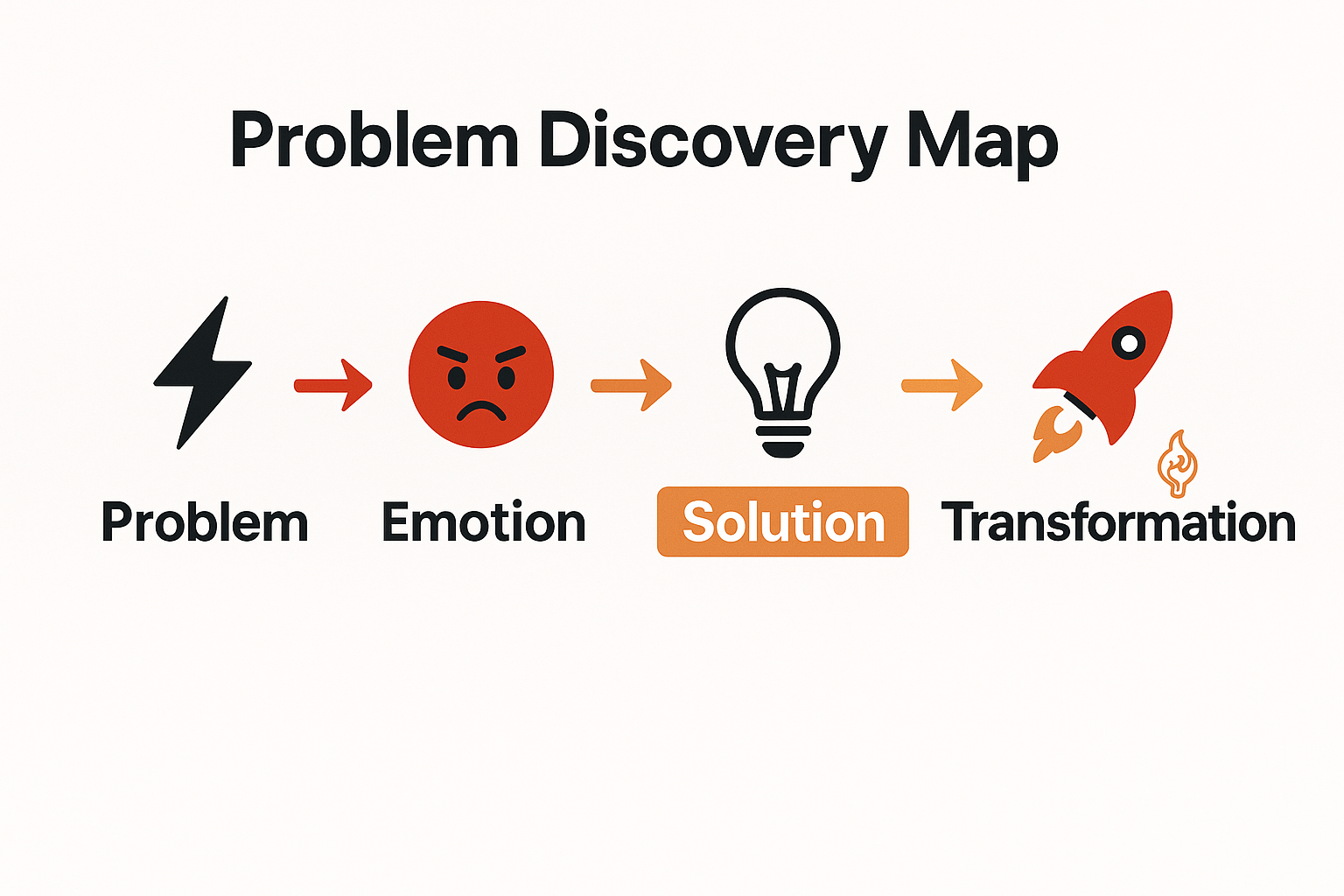
(Diagram: “Problem → Frustration → Emotional Trigger → Solution → Transformation”)
Step 1 – List Problems You See
“Parents don’t have time to cook healthy meals.”
“New freelancers don’t know how to find clients.”
“Small businesses waste money on bad marketing.”
Step 2 – Identify Emotional Triggers
Stress, confusion, fear, guilt, frustration.
Step 3 – Identify Desired Transformations
Time freedom, clarity, confidence, peace of mind, belonging.
🧠 Example:
Problem: “I can’t stay consistent on social media.”
Transformation: “Confidence and clients through consistent visibility.”
Business: “A done-for-you content calendar + accountability coaching.”
📊 Page 4: The Profitability Reality Check
Purpose: Go beyond passion — test demand early.
Diagram: “Pay Certainty Matrix”
Low Willingness to PayHigh Willingness to PayLow Ability to PayHobby markets (e.g., journaling, crafts)Emerging growth (e.g., student apps)High Ability to PayLow competition, untapped (e.g., business-to-business services)Golden Goose Zone ✅ (e.g., health, productivity, money, relationships)
💬 EOF Example:
Skill: Nutrition coaching → Target: Busy professionals
They can pay and want the result → Golden Goose idea.
🧠 Page 5: Validate the Market Fast
Purpose: Reduce risk and move to real-world testing.
ActionWhy It MattersHow to ExecuteTalk to 5 peopleReal-world pain validationAsk: “What frustrates you about ___?”Research demandAvoid building in a vacuumCheck Google Trends, Reddit, QuoraOffer a mini versionBuild trust and get early winsTry a 1-hour consult, $20 eBook, beta groupDocument reactionsData = directionNote exact language they use
📈 EOF Tip: Focus on proof, not perfection.
A $1 test beats a $1,000 assumption.
💰 Page 6: Business Modeling Canvas (Simplified)
(Diagram similar to Lean Canvas, branded in EOF colors)
SectionExampleYour NotesProblem“People can’t stay consistent with fitness.”Solution“Accountability + small daily challenges.”Audience“Professionals 30–45 with no time for gyms.”Unique Offer“5-minute workouts + AI accountability app.”Channels“Instagram Reels, TikTok, email list.”Revenue“Monthly subscription.”
🔥 EOF Shortcut:
Can your idea be explained in 1 sentence?
“I help [who] solve [problem] so they can [result].”
🚀 Page 7: Bonus Section – When There’s a Need Without Passion
“Sometimes the best opportunity isn’t the one that excites you — it’s the one that funds your freedom.”
QuestionExampleYour ResponseDo I have access to resources or expertise in this market?“My cousin owns a roofing company — I could manage leads.”Could this business run without my daily involvement?“An e-commerce store using dropshipping automation.”Can profits from this fund what I am passionate about later?“Using consulting income to build a community center.”Is this a short-term build or long-term play?“Launch → systemize → delegate.”
💬 EOF Insight: Passion can be built through progress. Freedom often starts with opportunity.
🧩 Page 8: Bringing It Together — The “Spark-to-Strategy” Map
(Diagram: four connected icons → Brain ⚙️ → Heart ❤️ → Rocket 🚀 → Dollar 💵)
StepReflectionExample1️⃣ Passion/Skill“I love writing and teaching.”2️⃣ Problem“Entrepreneurs struggle to write content.”3️⃣ Solution“A done-for-you email and post package.”4️⃣ Transformation“Confidence, time saved, more leads.”
✅ Circle the ONE that feels clear, profitable, and energizing.
Next Step:
Move it into a one-page business plan using EOF’s “Launch Blueprint.”
🏁 Page 9: EOF Action Plan
TaskTimelineNotesChoose one business ideaDay 1Validate with 5 peopleWeek 1Build a small test offerWeek 2Gather feedbackWeek 3Refine & relaunchWeek 4
🔥 EOF Motto:
“You don’t need permission. You just need a plan.”
🧠 Footer
Created by Entrepreneurs on Fire
🔥 Helping ordinary people become extraordinary entrepreneurs—one spark at a time.
entrepreneursonfire.net

Basic
Add your pricing strategy. Be sure to include important details like value, length of service, and why it’s unique.

Intermediate
Add your pricing strategy. Be sure to include important details like value, length of service, and why it’s unique.

Advanced
Add your pricing strategy. Be sure to include important details like value, length of service, and why it’s unique.